1. Introduction
The field of mathematics education is constantly developing, and today there is a strong desire for programs that engage students at a deeper level, while teaching them to use their mathematical knowledge to make a difference in the world. In this changing landscape, the role of mathematics in pre-service teacher education and as a field of research is changing, and it is not yet clear which aspects of this change will be of long-term significance. There is evidence that participating in modeling activities can lead to deep changes in preservice teachers' conceptions of mathematics, from merely abstract to also a handy tool for solving problems in the real world
| [17] | Cetinkaya, B., Kertil, M., Erbas, A. K., Korkmaz, H., Alacaci, C., & Cakiroglu, E. (2016). Pre-service Teachers’ Developing Conceptions about the Nature and Pedagogy of Mathematical Modeling in the Context of a Mathematical Modeling Course. Mathematical Thinking and Learning, 18(4), 287-314.
https://doi.org/10.1080/10986065.2016.1219932 |
| [21] | Duatepe-Paksu, A., Kazak, S., & Çontay, E. G. (2022). Evaluation of Mathematics Activities. |
[17, 21]
. Such a transformation is particularly essential for teachers planning to work in urban communities, where students often grapple with the ‘cultural contradictions and economic hardships that significantly impact the way they make sense of their world.
Traditional teaching of mathematics has been relatively teacher-centric, but engagement in mathematical modeling fosters a more constructivist orientation to the subject. The preservice teachers start to perceive mathematics as a process, dynamic, and necessary to cope with real problems
| [17] | Cetinkaya, B., Kertil, M., Erbas, A. K., Korkmaz, H., Alacaci, C., & Cakiroglu, E. (2016). Pre-service Teachers’ Developing Conceptions about the Nature and Pedagogy of Mathematical Modeling in the Context of a Mathematical Modeling Course. Mathematical Thinking and Learning, 18(4), 287-314.
https://doi.org/10.1080/10986065.2016.1219932 |
| [21] | Duatepe-Paksu, A., Kazak, S., & Çontay, E. G. (2022). Evaluation of Mathematics Activities. |
[17, 21]
. Modeling by itself is a cyclic and iterative process, and the iterative quality of model-based teaching not only improves their understanding of mathematical modeling tasks, but also their perspectives of the unfolding roles of the teacher and the student in the process
| [17] | Cetinkaya, B., Kertil, M., Erbas, A. K., Korkmaz, H., Alacaci, C., & Cakiroglu, E. (2016). Pre-service Teachers’ Developing Conceptions about the Nature and Pedagogy of Mathematical Modeling in the Context of a Mathematical Modeling Course. Mathematical Thinking and Learning, 18(4), 287-314.
https://doi.org/10.1080/10986065.2016.1219932 |
[17]
. Similarly, experiential-learning approaches, like the Enhancement, Learning, and Reflection (ELR) process, have been found to have a major effect on pre-service teachers’ self-efficacy to teach mathematical modelling content
This increased confidence is important given that preparedness to teach geometry through modeling is a strong indicator for higher engagement from students and deeper understanding of geometric ideas
.
In addition to changes in attitudes and self-efficacy, pedagogical interventions on mathematical modeling instruction may be able to help the pre-service teachers' pedagogical content related to mathematical modeling. This also involves preservice teachers’ competences to design and implement reasonable modelling tasks and appropriate student support in heterogeneous classroom situations
| [25] | Greefrath, G., Siller, H.-S., Klock, H., & Wess, R. (2021). Pre-service secondary teachers’ pedagogical content knowledge for the teaching of mathematical modelling. Educational Studies in Mathematics, 109(2), 383-407.
https://doi.org/10.1007/s10649-021-10038-z |
[25]
. Participating in a variety of student practices while participating in modeling activities can also affect preservice teacher beliefs about promoting student learning in general, helping them to see and respect multiple ways to knowing
| [17] | Cetinkaya, B., Kertil, M., Erbas, A. K., Korkmaz, H., Alacaci, C., & Cakiroglu, E. (2016). Pre-service Teachers’ Developing Conceptions about the Nature and Pedagogy of Mathematical Modeling in the Context of a Mathematical Modeling Course. Mathematical Thinking and Learning, 18(4), 287-314.
https://doi.org/10.1080/10986065.2016.1219932 |
[17]
.
Mathematics education in Ghana’s urban cities and towns such as Accra, Kumasi, Tamale, Yendi, Bimbilar etc unfolds within complex social and economic structures shaped by rapid urbanisation, resource disparities, and cultural heterogeneity
| [13] | Boateng, V. (2024). Comparative study of three secondary cities in Metropolitan Accra [Unpublished doctoral dissertation]. University of Ghana. |
| [40] | Young, J. (2023). The role of technology in enhancing urban mathematics education. Journal of Urban Mathematics Education, 16(1), 1-13. https://journals.tdl.org/jume |
[13, 40]
. Recent studies of the Sagnarigu Municipality in northern Ghana, for instance, reveal how spatial congestion, land-use competition, and uneven access to educational infrastructure mirror broader inequalities that influence learning opportunities and pedagogical practices
| [1] | Abubakari, M. M., Anaman, K. A., & Ahene-Codjoe, A. A. (2022). Urbanization and arable land use in Northern Ghana: A case study of the Sagnarigu Municipality in the Greater Tamale Area. Applied Economics and Finance, 9(1), 68-81.
https://doi.org/10.11114/aef.v9i1.5469 |
[1]
Urban schooling in this sense is not simply geographical but sociocultural and political, entailing systemic inequities, linguistic diversity, and tensions between imported curricular traditions and local epistemologies. Within these environments, the challenge of teaching mathematics lies in reconciling globally standardised content with the lived experiences of learners whose communities are often marginalised in formal educational narratives.
Urban mathematics education in Ghana is shaped by disparities in school resourcing, teacher deployment, and learner opportunities. For instance, urban teacher-education institutions in Tamale and Accra often serve students from linguistically diverse and economically marginalized backgrounds. These inequities influence teacher confidence, pedagogical beliefs, and access to technology for modelling instruction
| [3] | Aguirre, J., Mayfield-Ingram, K., & Martin, D. B. (2013). The impact of identity in K-8 mathematics learning and teaching: Rethinking equity-based practices. National Council of Teachers of Mathematics / Routledge. |
| [40] | Young, J. (2023). The role of technology in enhancing urban mathematics education. Journal of Urban Mathematics Education, 16(1), 1-13. https://journals.tdl.org/jume |
[3, 40]
. Integrating mathematical modelling, therefore, represents not just a pedagogical reform but a step toward addressing educational justice in urban settings.
In this study, the term
urban Ghana is therefore used analytically rather than descriptively. Following
| [40] | Young, J. (2023). The role of technology in enhancing urban mathematics education. Journal of Urban Mathematics Education, 16(1), 1-13. https://journals.tdl.org/jume |
[40]
urban mathematics education is conceptualised as a critical site where issues of access, identity, and power intersect with pedagogy. Mathematical modelling becomes a pedagogical bridge that connects abstract geometry with the tangible realities of city life like transport routing, market-space optimisation, or housing-density planning. This enables teachers to transform mathematics into a language for understanding and improving their communities. This approach resonates with
| [3] | Aguirre, J., Mayfield-Ingram, K., & Martin, D. B. (2013). The impact of identity in K-8 mathematics learning and teaching: Rethinking equity-based practices. National Council of Teachers of Mathematics / Routledge. |
[3]
who argue that culturally responsive mathematics teaching links content to students’ sociocultural identities and challenges deficit perspectives. Accordingly, the present intervention positions modelling not merely as a teaching technique but as an equity-oriented practice that empowers pre-service teachers to engage urban learners through tasks that are meaningful, situated, and socially responsive.
2. Literature Review
2.1. Theoretical and Conceptual Framework
This study is grounded in
| [8] | Bandura, A. (1977). Self-efficacy: Toward a unifying theory of behavioral change. Psychological Review, 84(2), 191-215.
https://doi.org/10.1037/0033-295X.84.2.191 |
| [9] | Bandura, A. (1986). Social foundations of thought and action. Upper Saddle River, NJ: Prentice Hall. |
| [10] | Bandura, A. (1997). Self-efficacy: The exercise of control. New York: W. H. Freeman. |
[8-10]
Social Cognitive Theory, which conceptualises human functioning as the dynamic interaction among personal, behavioural, and environmental determinants. Central to this theory is
self-efficacy, an individual’s belief in their capacity to organise and execute the actions required to achieve specific performances. In teacher education, self-efficacy has been shown to predict classroom management, instructional innovation, and perseverance in the face of contextual constraints
| [29] | Klassen, R. M., & Tze, V. M. C. (2014). Teachers’ self-efficacy, personality, and teaching effectiveness: A meta-analysis. Educational Research Review, 12(4), 59-76.
https://doi.org/10.1016/j.edurev.2014.06.001 |
| [35] | Tschannen-Moran, M., & Woolfolk Hoy, A. (2001). Teacher efficacy: Capturing an elusive construct. Teaching and Teacher Education, 17(7), 783-805.
https://doi.org/10.1016/S0742-051X(01)00036-1 |
[29, 35]
. Bandura identifies four principal sources of self-efficacy: mastery experiences, vicarious experiences, verbal persuasion, and physiological and affective states. Each of these sources is deliberately embedded within the mathematical modelling intervention developed for this study.
During the modelling cycle (problem analysis, mathematization, solution, interpretation, and validation) participants engage in authentic geometry tasks drawn from urban Ghanaian contexts, thereby generating mastery experiences through successful problem completion
| [11] | Blum, W. (2011). Can modelling be taught and learnt? Some answers from empirical research. Trends in teaching and learning of mathematical modelling: ICTMA14, 15-30. |
[11]
. Observing peers’ approaches and discussing alternative solutions cultivate vicarious learning, while guided feedback from tutors and colleagues provides verbal persuasion that reinforces confidence in teaching complex concepts. The supportive and collaborative learning environment helps regulate physiological states, mitigating anxiety often associated with mathematics teaching. Through these mechanisms, the intervention operationalises Bandura’s framework in ways that directly strengthen
task-specific teacher efficacy for geometry-through-modelling.
The integration of mathematical modelling pedagogy with self-efficacy theory is further underpinned by constructivist assumptions that knowledge is actively constructed through problem solving in authentic settings
| [12] | Blum, W., & Borromeo Ferri, R. (2009). Mathematical modelling: Can it be taught and learnt. Journal of mathematical modelling and application, 1(1), 45-58. |
| [20] | Czocher, J. A., Melhuish, K., & Kandasamy, S. S. (2020). Building mathematics self-efficacy of STEM undergraduates through mathematical modelling. International Journal of Mathematical Education in Science and Technology, 51(6), 807-834. |
[12, 20]
. Modelling tasks serve as cognitive scaffolds through which pre-service teachers connect mathematical ideas to real-world phenomena and, in the process, reconstruct their pedagogical beliefs about what it means to learn and teach geometry. As participants gain confidence in facilitating modelling tasks, they develop stronger beliefs in students’ capacity to reason mathematically, a finding consistent with research linking efficacy growth to student-centred instructional orientations
| [7] | Axelsen, T., Galligan, L., & Woolcott, G. (2017). The modelling process and pre-service teacher confidence. Mathematics Education Research Group of Australasia, 93-100.
https://files.eric.ed.gov/fulltext/ED589528.pdf |
| [31] | McCormick, M. L. (2022). Teacher perceptions of the opportunities and constraints when integrating problem solving in student-centred mathematics teaching and learning (Doctoral dissertation, Monash University). |
| [35] | Tschannen-Moran, M., & Woolfolk Hoy, A. (2001). Teacher efficacy: Capturing an elusive construct. Teaching and Teacher Education, 17(7), 783-805.
https://doi.org/10.1016/S0742-051X(01)00036-1 |
[7, 31, 35]
.
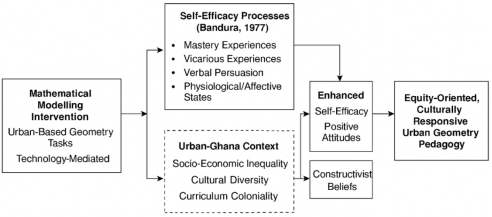
Figure 1. Conceptual Framework Integrating Mathematical Modelling, Self-Efficacy Processes, and Urban Contexts in Geometry Teaching.
The framework illustrates how the mathematical modelling intervention (independent variable) operates through Bandura’s four self-efficacy processes which include mastery, vicarious, verbal, and affective regulation. They serve as mediating variables that enhance pre-service teachers’ self-efficacy, attitudes, and constructivist beliefs. The Urban Ghana context functions as a moderating variable influencing these processes, culminating in the dependent variable: equity-oriented, culturally responsive urban geometry pedagogy.
Situated within the realities of Ghana’s urban schools, the conceptual framework therefore links three interrelated dimensions: (1) the
Mathematical Modelling Intervention as the independent variable; (2) the
self-efficacy processes (mastery, vicarious, verbal, physiological) as mediating mechanisms; and (3) the
development of geometry-specific pedagogical beliefs and practices as dependent outcomes. Contextual moderators include the socio-economic and infrastructural conditions of urban schools such as large class sizes, limited teaching resources, and linguistic diversity which influence how self-efficacy beliefs are enacted. This framing advances a culturally responsive, justice-oriented perspective on mathematics teacher education, emphasis on equity, criticality, and urban relevance
| [1] | Abubakari, M. M., Anaman, K. A., & Ahene-Codjoe, A. A. (2022). Urbanization and arable land use in Northern Ghana: A case study of the Sagnarigu Municipality in the Greater Tamale Area. Applied Economics and Finance, 9(1), 68-81.
https://doi.org/10.11114/aef.v9i1.5469 |
| [40] | Young, J. (2023). The role of technology in enhancing urban mathematics education. Journal of Urban Mathematics Education, 16(1), 1-13. https://journals.tdl.org/jume |
[1, 40]
.
This intervention fosters crucial mediating variables like enhanced Attitudes towards Mathematical Modeling, increased Self-Efficacy or confidence in teaching Geometry through Modeling, and a shift towards Constructivist Beliefs about Student Learning. Together, these changes empower future educators to implement student-centered, inquiry-based geometry instruction that is deeply relevant to the diverse experiences of urban learners. Ultimately, this framework posits that by preparing teachers to connect geometry to the lived realities of city life, we can significantly improve student engagement and conceptual understanding within urban mathematics education.
2.2. Empirical Review
Mathematical modelling has gained growing attention with regard to the modern mathematics education, and is treated as an instrumental force to link the abstract mathematical theories with the tangible real problems
| [32] | Meylani D. R. (2025). Reimagining mathematical modeling pedagogy: A systematic review of strategies for preservice teacher education. International Journal of Education Science (IJES), 2(1). |
[32]
. Its importance in the case of developing preservice teachers is even greater, as it determines their future teaching methods and heightens their appreciation of mathematics as a lively problem-solving enterprise
| [30] | Lerman, S. (2020). Constructivism in mathematics education. In S. Lerman (Ed.), Encyclopedia of Mathematics Education (pp. 1-5). Springer. |
| [37] | von Glasersfeld, E. (2003). Review of “Beyond constructivism, models and modeling perspectives on mathematics problem solving, learning, and teaching”. ZDM, 35(6), 327-328. |
[30, 37]
. Although there are well-researched advantages of using mathematical modeling
| [24] | Greefrath, G., Hertleif, C., & Siller, H. S. (2018). Mathematical modelling with digital tools—a quantitative study on mathematising with dynamic geometry software. Zdm, 50(1), 233-244. |
[24]
for preservice teachers, there is a yawning knowledge deficit in studies that looked into the relationships and processes of change in pre-service teachers’ attitudes, self-efficacy, and beliefs, particularly in terms of geometry instruction in urban schools in Ghana. We use existing empirical evidence to identify this critical gap.
The empirical evidence consistently shows that such an engagement with mathematical modelling tasks can radically transform student-teachers' images of mathematics.
| [26] | Guerrero-Ortiz, C., & Borromero Ferri, R. (2022). Pre-service teachers' challenges in implementing mathematical modelling: Insights into reality. PNA, 16(4), 309-341.
https://doi.org/10.30827/pna.v16i4.21329 |
[26]
noted that preservice teachers, without specific prepared instruction, designed modelling tasks that are word problems and perceive that interventions are needed to change conceptions of the applications of mathematics. It is in line with the fact that mathematics is applicable to everyday life specifically, as observed by
| [2] | Agbata, B. C., Obeng-Denteh, W., Kwabi, P. A., Abraham, S., Okpako, S. O., Arivi, S. S., Asante-Mensa, F., & Adu Gyamfi, W. K. (2024). Everyday uses of mathematics and the roles of a mathematics teacher. Science World Journal, 19(3).
https://dx.doi.org/10.4314/swj.v19i3.29 |
[2]
and authentic activities undertaken in real environments have been shown to enhance students’ mathematical engagement and understanding
. In addition, experiences of modeling appear to promote teachers’ movement toward constructivist orientations to teaching, such as valuing students’ multiple ways of thinking and using more student-centered practices
| [32] | Meylani D. R. (2025). Reimagining mathematical modeling pedagogy: A systematic review of strategies for preservice teacher education. International Journal of Education Science (IJES), 2(1). |
[32]
. But one consistent limitation across much of this literature is that few overtly consider the ways in which these pedagogical shifts particularly address the needs of diverse urban classrooms, something that studies such as
| [5] | Alazemi, B. A. H. E. (2018). Exploring Pre-Service Special and General Education Teachers' Beliefs and Attitudes in Mathematics and Learning and Teaching Mathematics [Unpublished doctoral dissertation]. University of Northern Colorado. |
[5]
offer groundwork but not model-specific insight into.
Self-efficacy in teaching with mathematical modeling is very related with mastery learning and experience learning. Mathematical self-efficacy as a significant predictor of mathematical modeling performance was found by
| [27] | Holenstein, M., Bruckmaier, G., & Grob, A. (2022). How do self-efficacy and self-concept impact mathematical achievement? The case of mathematical modelling. British Journal of Educational Psychology, 92(1), 155-174.
https://doi.org/10.1111/bjep.12443 |
[27]
, indicating that the direct involvement in modeling tasks may increase self-efficacy in teaching mathematical modeling for pre-service teachers. Similarly,
| [39] | Yesilyurt, E., Deniz, H., & Kaya, E. (2021). Exploring sources of engineering teaching self-efficacy for pre-service elementary teachers. International Journal of STEM Education, 8(1), 42. https://doi.org/10.1186/s40594-021-00299-8 |
[39]
found that focused instructional elements can increase engineering teaching self-efficacy and assumed that similar gains could be achieved among mathematics teachers. Although
| [28] | Jablonski, S., & Ludwig, M. (2022). Teaching and learning of geometry—A literature review on current developments in theory and practice. Education Sciences, 12(1), 22.
https://doi.org/10.3390/educsci12010022 |
[28]
conducted an extensive literature review on geometry education, research on how to improve self-efficacy in geometry teaching by way of mathematical modeling, especially in urban settings, is relatively sparse. This lack of knowledge also applies to the role of the other sources of self-efficacy (vicarious experiences and verbal persuasion) for building self-efficacy to teach in this setting.
Mathematical modeling studies in Ghana and overall sub-Saharan African setting is growing which provides useful localized perspectives.
| [14] | Bonyah, E., & Clark, L. J. (2022). Pre-service teachers' perceptions of and knowledge for mathematical modelling in Ghana. Contemporary Mathematics and Science Education, 3(1), ep22011. https://doi.org/10.30935/conmaths/11932 |
[14]
examined pre-service teachers' views and understanding of mathematical modelling in Ghana, focusing on their readiness and difficulties.
| [4] | Akosah, E. F., Arthur, Y. D., & Obeng, B. A. (2025). Unveiling the nexus: Teachers' self-efficacy on realistic mathematics education via structural equation modeling approach. International Journal of Didactical Studies, 6(1), 29184.
https://doi.org/10.33902/ijods.202529184 |
[4]
played an important role in that, it was found that the impact of teacher’s method of teaching on students' performance at the junior high school level was mediated through teachers’ self-efficacy, thus, indicating that what really mattered for the teacher in the classroom was confidence.
| [6] | Amusuglo, M. K. (2025). Development of knowledge and skills in initial mathematics teacher education and early years of teaching career in Ghanaian Basic Schools [Unpublished doctoral thesis]. Charles University. |
[6]
adds to knowledge about knowledge and skill development of beginning mathematics teachers in Ghana. These studies, as seminal as they may be, also tend not to explicitly grapple with the unique "urban" challenges, lack of resources, or student population that are specific to the urban schools in Ghana as discussed by
| [13] | Boateng, V. (2024). Comparative study of three secondary cities in Metropolitan Accra [Unpublished doctoral dissertation]. University of Ghana. |
| [40] | Young, J. (2023). The role of technology in enhancing urban mathematics education. Journal of Urban Mathematics Education, 16(1), 1-13. https://journals.tdl.org/jume |
[13, 40]
within the broader phenomenon of urban education.
In sum, the empirical literature includes positive findings on the effect of mathematical modelling on teachers' attitudes, beliefs and self-efficacy. Nevertheless, there is a gap in the research literature in terms of the intricate nature of change, particularly the contextual factors that influence shift in geometry instruction in urban Ghana. The novelty of this study lies in addressing the foregoing but using a convergent parallel mixed-methods study design to gain in-depth insights into the inter-relationships between attitude, self-efficacy and beliefs, as well as locating its exploration within the under-researched terrain of urban teacher education in Ghana, explicitly situating its inquiry in Bandura’s Self-Efficacy Theory (SET). Drawing on our ongoing experimentation, it provides a more understanding of the ways in which mathematical modeling interventions can promote preservice teachers’ capacity to teach geometry in diverse urban schools, a contribution to the field of mathematics teacher education.
3. Materials and Methods
This study adopted a convergent parallel mixed-methods design because it allows the researcher to examine the measurable effects of an instructional intervention while simultaneously exploring the lived experiences that explain those effects. Quantitative and qualitative data were collected concurrently, analysed independently, and then integrated during interpretation to generate meta-inferences that deepen understanding of the phenomenon
| [19] | Creswell, J. W., & Plano Clark, V. L. (2018). Designing and Conducting Mixed Methods Research. SAGE. |
[19]
. The pragmatic rationale for this design aligns with the study’s aim of evaluating both cognitive gains and pedagogical transformations arising from mathematical-modelling instruction.
The study was conducted in two public Colleges of Education located in urban towns within the Northern Region of Ghana, approximately 72 kilometres apart. Out of the four Colleges of Education in the region, two institutions that share a common boundary were excluded from the main study: one was randomly selected for piloting the instruments, and the other was omitted to prevent contamination of the experimental treatment.
The two remaining colleges participated in the main intervention. Both are situated in developing urban municipalities, Yendi and Bimbila that represent the contextual realities of urban teacher education in Northern Ghana
| [34] | Tamanja, E. M. J., & Pagra, M. M. K. (2017). Teaching and learning challenges of teachers in rural areas in Ghana: The case of basic schools teachers in the Wa West District. In Proceedings of the 10th International Conference of Education, Research and Innovation (ICERI2017) (pp. 5382-5388). IATED Academy. https://doi.org/10.21125/iceri.2017.1277 |
[34]
. The pre-test mean scores on the Geometry Achievement Test were used to assign treatment conditions: the college with the lower mean became the experimental group, while the other served as the control group.
In total, 138 third-year pre-service teachers enrolled in the course
Teaching and Assessing Mathematics participated. Intact classes were used: 75 students formed the experimental group and 63 students the control group. Intact classes were maintained because random assignment at the individual level was impractical in institutional settings—a procedure consistent with quasi-experimental conventions in education
| [18] | Cook, T. D., & Campbell, D. T. (1979). Quasi-Experimentation: Design & Analysis Issues for Field Settings. |
[18]
.
The intervention spanned twelve weeks, comprising six mathematical-modelling cycles guided by
| [11] | Blum, W. (2011). Can modelling be taught and learnt? Some answers from empirical research. Trends in teaching and learning of mathematical modelling: ICTMA14, 15-30. |
[11]
modelling framework. Each cycle involved the phases of
problem analysis, mathematization, model formulation, solution, interpretation, and
validation. Tasks were contextually grounded in authentic urban problems drawn from Yendi and Bimbila, including geometry topics such as lines, plane shapes, perimeter, area, volume, and angles. The problems required participants to model local phenomena, for example, estimating market-shed roofing materials, designing rectangular classroom layouts, and determining optimal water-tank volumes, using GeoGebra as a mediating tool.
Weekly reflection sessions, peer presentations, and group critiques were structured to provide mastery experiences, vicarious learning, verbal persuasion, and emotional regulation, corresponding to
| [10] | Bandura, A. (1997). Self-efficacy: The exercise of control. New York: W. H. Freeman. |
[10]
four sources of self-efficacy. The control group received conventional teacher-centred geometry instruction covering identical content without the modelling or technology component.
Quantitative data were collected using validated pre- and post-intervention questionnaires designed to measure changes in participants’ attitudes toward mathematical modelling, their self-efficacy in teaching geometry, and their pedagogical beliefs. Concurrently, qualitative data were gathered through semi-structured interviews, which explored the processes underlying these changes and provided rich insights into participants’ evolving understanding and confidence.
All items in the Geometry Self-Efficacy Scale and Modelling Competency Rubric were adapted to reflect local classroom contexts (units, examples, and terminology familiar to Ghanaian pre-service teachers). The instruments were reviewed by two mathematics education experts to ensure content validity and contextual relevance for Ghanaian teacher education. A pilot study involving 30 students from the excluded College of Education established internal consistency, yielding Cronbach’s α values between 0.81 and 0.89. Minor linguistic adjustments were made to reflect local terminology and classroom realities, ensuring the instruments were both reliable and culturally appropriate.
Quantitative data were analysed using non-parametric statistics because Kolmogorov-Smirnov and Shapiro-Wilk tests confirmed significant departures from normality (p <.001). The Wilcoxon Signed-Rank, Mann-Whitney U, and Rank ANCOVA tests were employed for within- and between-group comparisons due to their robustness with non-normal data and unequal group sizes
| [23] | Field, A. (2018). Discovering Statistics Using IBM SPSS Statistics (5th ed.). SAGE. |
[23]
. Statistical significance was set at
p <.05 following APA 7 guidelines.
Qualitative data were analysed thematically following
| [15] | Braun, V., & Clarke, V. (2006). Using thematic analysis in psychology. Qualitative Research in Psychology, 3(2), 77-101. |
[15]
six-phase framework: familiarisation, coding, theme generation, review, definition, and reporting. Coding was conducted by two independent researchers, with inter-coder discussions used to resolve discrepancies. The interview recordings were transcribed verbatim using Otta transcription software, which enhanced accuracy and efficiency in preparing textual data for analysis. Subsequent coding and thematic organization were conducted manually following the steps of thematic analysis outlined by
| [33] | Nowell, L. S., Norris, J. M., White, D. E., & Moules, N. J. (2017). Thematic analysis: Striving to meet the trustworthiness criteria. International Journal of Qualitative Methods, 16(1), 1-13. https://doi.org/10.1177/1609406917733847 |
[33]
to ensure transparency and traceability of interpretations.
Triangulation was achieved through methodological integration of quantitative (questionnaire) and qualitative (interview) data sources within the convergent parallel design. The questionnaire captured trends in pre-service teachers’ self-efficacy and perceptions, while the interviews provided explanatory depth regarding these patterns. To enhance trustworthiness, a second researcher reviewed 25% of the coded transcripts, and discrepancies were resolved through consensus discussions
| [33] | Nowell, L. S., Norris, J. M., White, D. E., & Moules, N. J. (2017). Thematic analysis: Striving to meet the trustworthiness criteria. International Journal of Qualitative Methods, 16(1), 1-13. https://doi.org/10.1177/1609406917733847 |
| [19] | Creswell, J. W., & Plano Clark, V. L. (2018). Designing and Conducting Mixed Methods Research. SAGE. |
[33, 19]
.
All research procedures were rigorously reviewed and approved by the relevant Institutional Review Board (AAMUSTED/IERC/2024/009) at Akenten Appiah-Menka University of Skills Training and Entrepreneurial Development. All participants were provided with a detailed consent process, which included the purpose and procedure of the study, risks, and benefits. Before collecting any data, written consent was obtained from all pre-service teachers. Anonymity and confidentiality were preserved by de-identifying information in the study. Participants were expressly told that they could withdraw their participation at any time without penalty. The research followed all the ethical guidelines for research with human subjects to guarantee the well-being of the participants and the integrity of the data.
4. Results
The presentation of results in this section is grounded in the theoretical foundations established earlier. Specifically, the interpretation of the findings draws on
| [10] | Bandura, A. (1997). Self-efficacy: The exercise of control. New York: W. H. Freeman. |
[10]
Social Cognitive Theory and
| [11] | Blum, W. (2011). Can modelling be taught and learnt? Some answers from empirical research. Trends in teaching and learning of mathematical modelling: ICTMA14, 15-30. |
[11]
Modelling Cycle, which together explain how cognitive, behavioural, and contextual factors interact during learning. Accordingly, the statistical and qualitative outcomes that follow are not merely descriptive but illustrate how the mathematical-modelling intervention activated self-efficacy processes, mastery, vicarious, verbal, and affective experiences through successive modelling stages of analysis, mathematization, validation, and reflection.
4.1. Quantitative Results
The analysis compared pre-service teachers from two Colleges of Education located in the urban towns of Yendi and Bimbila in Northern Ghana. These analyses evaluate the impact of the 12-week modelling cycles described in the methodology on pre-service teachers’ self-efficacy, perceptions, and beliefs. These settings represent comparable urban educational contexts characterised by high enrolments and limited resources typical of Ghana’s urban teacher-education landscape.
Demographics
The demographic information of the 138 pre-service teachers (75 experimental, 63 control) is displayed in
Table 1. The groups were statistically equivalent on relevant demographic variables including age, gender breakdown, and previous teaching experience (all p >. 05). These similarities indicate that differences observed post-intervention are less likely due to prior characteristics of study participants.
Table 1. Participants’ Demographic Characteristics.
Demographics | Experimental Group (n=75) | Control Group (n=63) | p-value |
Age (years) | 21.3 ± 1.2 | 21.5 ± 1.1 | .32 |
Gender (% female) | 32% | 38% | .71 |
Prior teaching experience (%) | 28% | 31% | .68 |
Table 2. Normality Test for Each Construct.
Construct (Means) | Kolmogorov-Smirnov Statistic | df | Sig. | Shapiro-Wilk Statistic | df | Sig. |
Geometry Self Efficacy (Pre) | .202 | 138 | .000 | .877 | 138 | <.001 |
Geometry Self Efficacy (Post) | .157 | 138 | .000 | .834 | 138 | <.001 |
Mean Perception of modeling (Pre) | .142 | 138 | .000 | .886 | 138 | <.001 |
Perception of modeling (Post) | .144 | 138 | .000 | .944 | 138 | <.001 |
Believes about Learning Geometry (Pre) | .230 | 138 | .000 | .726 | 138 | <.001 |
Believes about Learning Geometry (Post) | .167 | 138 | .000 | .922 | 138 | <.001 |
Mathematical Modeling Intervention | .124 | 138 | .000 | .941 | 138 | <.001 |
Note. All significance values reported as .000 in SPSS outputs are presented as p <.001 (per APA 7).
As shown in
Table 2, both Kolmogorov-Smirnov and Shapiro-Wilk tests indicated that all constructs (pre- and post-intervention scores for geometry self-efficacy, perceptions of modeling, beliefs about learning geometry, and the mathematical modeling intervention) significantly deviated from a normal distribution (p <.001). This consistent non-normal distribution across all variables necessitated the use of non-parametric tests for subsequent analyses.
Assessment of Homogeneity of Variance for Pre- and Post-Intervention Constructs
Levene’s test for equality of variances (
Table 3) indicated significant violations of the equal variance assumption for most constructs (p <.001) in pre-intervention measures (Geometry Self-Efficacy, Perception of Modeling, Beliefs about Learning Geometry) and for post-intervention Geometry Self-Efficacy (p <.001) and Perception of Modeling (p =.002). Only 'Beliefs about Learning Geometry (Post)' showed equal variances (p =.530). These violations further supported the use of non-parametric tests.
Table 3. Homogeneity Test for Each Construct.
Construct | Levene Statistic | df1 | df2 | Sig. |
Geometry Self Efficacy (Pre) | 111.313 | 1 | 136 | <.001 |
Geometry Self Efficacy (Post) | 58.177 | 1 | 136 | <.001 |
Perception of modeling (Pre) | 31.567 | 1 | 136 | <.001 |
Perception of modeling (Post) | 10.051 | 1 | 136 | .002 |
Believes about Learning Geometry (Pre) | 330.771 | 1 | 136 | <.001 |
Believes about Learning Geometry (Post) | 0.396 | 1 | 136 | .530 |
Mathematical Modeling Intervention | 36.020 | 1 | 136 | <.001 |
Note. All significance values reported as .000 in SPSS outputs are presented as p <.001 (per APA 7).
Descriptive Analysis of Pre- and Post-Intervention Constructs by Group
Table 4 presents descriptive statistics. Pre-intervention, the experimental group exhibited lower mean geometry self-efficacy, perception of modeling, and beliefs about learning geometry compared to the control group. Post-intervention, the experimental group demonstrated a notable increase across all constructs. This included a significant reversal in the pattern for perception of modeling and beliefs about learning geometry, where the experimental group then showed considerably higher means. The control group showed only slight increases across these measures.
Table 4. Descriptive Statistics for Each Construct.
Construct | Group | N | Mean | Std. Deviation |
Geometry Self Efficacy (Pre) | Control Group | 63 | 2.4524 | .75831 |
| Experimental Group | 75 | 1.7439 | .32207 |
| Total | 138 | 1.9331 | .57094 |
Geometry Self Efficacy (Post) | Control Group | 63 | 2.5523 | .80410 |
| Experimental Group | 75 | 2.5014 | .50244 |
| Total | 138 | 2.3013 | .70110 |
Perception of modeling (Pre) | Control Group | 63 | 2.6588 | .85069 |
| Experimental Group | 75 | 1.6086 | .52826 |
| Total | 138 | 1.8890 | .78206 |
Perception of modeling (Post) | Control Group | 63 | 2.2627 | .71385 |
| Experimental Group | 75 | 3.3543 | 1.00053 |
| Total | 138 | 3.0628 | 1.04923 |
Believes about Learning Geometry (Pre) | Control Group | 63 | 2.8196 | .95687 |
| Experimental Group | 75 | 1.2471 | .33895 |
| Total | 138 | 1.6670 | .90082 |
Believes about Learning Geometry (Post) | Control Group | 63 | 2.4000 | .93209 |
| Experimental Group | 75 | 3.4286 | .89878 |
| Total | 138 | 3.1539 | 1.01379 |
Mathematical Modeling Intervention | Control Group | 63 | 2.3137 | .45472 |
| Experimental Group | 75 | 3.2690 | .84568 |
| Total | 138 | 3.0140 | .87016 |
Inferential Analysis
Wilcoxon Signed Rank Test Results for the Control Group (Pre vs. Post-Intervention)
As presented in
Table 5, the Wilcoxon Signed Rank Test for the control group (N=63) revealed no statistically significant changes in geometry self-efficacy (p=0.270), perception of modeling (p=0.372), or beliefs about learning geometry (p=0.221) between pre- and post-intervention. Effect sizes (r = 0.12 to 0.17) were trivial, indicating that observed minor differences were likely due to normal fluctuations rather than structured interventions.
Table 5. Wilcoxon Signed Rank Test Results for Control Group (Pre vs. Post-Intervention).
Variable | N | Mean Rank | Test Statistic (W) | Z-value | p-value | Effect Size (r) |
Geometry Self-Efficacy | 63 | 23.1 | 412.500 | 1.102 | 0.270 | 0.15 |
Perception of Modeling | 63 | 20.7 | 298.000 | -0.892 | 0.372 | 0.12 |
Beliefs About Learning Geo. | 63 | 19.5 | 275.500 | -1.224 | 0.221 | 0.17 |
Wilcoxon Signed Rank Test Results for the Experimental Group (Pre vs. Post-Intervention)
Table 6 summarizes the Wilcoxon Signed Rank Test results for the experimental group (N=75). Statistically significant positive shifts were found for geometry self-efficacy (Z=6.375, p<.001, r=0.54, medium-to-large effect), perception of mathematical modeling (Z=9.701, p<.000, r=0.820, large effect), and beliefs about learning geometry (Z=10.105, p<.000, r=0.854, large effect). These findings indicate a substantial positive impact of the mathematical modeling intervention on the experimental group.
Table 6. Wilcoxon Signed Rank Test Results for Pre and Post-Test Scores for the Experimental Group.
Variable | N | Test Statistic | Standard Error | Z-value | p-value | Effect Size (r) |
Geometry Self-Efficacy | 75 | 7850.000 | 400.00 | 6.375 | .001 | 0.54 |
Perception of Mathematical Modeling | 75 | 9357.000 | 470.216 | 9.701 | <.001 | 0.820 |
Beliefs About Learning Geometry | 75 | 9424.500 | 464.938 | 10.105 | <.001 | 0.854 |
Note. All significance values reported as .000 in SPSS outputs are presented as p <.001 (per APA 7).
Non-Parametric Analysis of Mathematical Modeling Intervention Effects on Pre-Service Teachers' Perceptions, Confidence, and Beliefs
The Mann-Whitney U test (
Table 7) compared the experimental and control groups. Post-intervention, the experimental group showed significantly higher geometry self-efficacy (Z=2.500, p=.012, r=0.18, small effect), perception of mathematical modeling (Z=-6.385, p<.001, r=0.46, medium effect), and beliefs about learning geometry (Z=-6.358, p<.001, r=0.46, medium effect) compared to the control group. This highlights the intervention's positive influence on these key outcomes.
These statistically significant post-test differences reflect the theoretical mechanisms articulated by
and
| [11] | Blum, W. (2011). Can modelling be taught and learnt? Some answers from empirical research. Trends in teaching and learning of mathematical modelling: ICTMA14, 15-30. |
[11]
. Participants in the experimental group repeatedly engaged in geometry tasks that demanded problem analysis, mathematization, and validation within the modelling cycle, thereby producing mastery experiences, Bandura’s most influential source of self-efficacy. Observation of peers’ strategies generated vicarious learning, while guided feedback and peer critique offered verbal persuasion, further strengthening confidence. The cyclical, success-oriented nature of the intervention thus explains the robust quantitative gains reported above.
Table 7. Mann-Whitney U Test Results Comparing Experimental and Control Groups with Effect Sizes.
Variable | Group | N | Mean Rank | Mann-Whitney U | Z-score | p-value (2-tailed) | Effect Size (r) |
Geometry Self-Efficacy (Pre) | Control | 63 | 133.68 | 1648.500 | -5.706 | <.001* | 0.41 (Medium) |
Experimental | 75 | 82.28 | | | | |
Geometry Self-Efficacy (Post) | Control | 63 | 85.00 | 1163.000 | 2.500 | .012 | 0.18 (small) |
Experimental | 75 | 105.00 | | | | |
Perception of Modeling (Pre) | Control | 63 | 145.80 | 1030.000 | -7.561 | <.001* | 0.55 (Large) |
Experimental | 75 | 77.86 | | | | |
Perception of Modeling (Post) | Control | 63 | 53.93 | 1424.500 | -6.385 | <.001* | 0.46 (Medium) |
Experimental | 75 | 111.33 | | | | |
Beliefs about Learning Geometry (Pre) | Control | 63 | 160.75 | 268.000 | -10.094 | <.001* | 0.73 (Large) |
Experimental | 75 | 72.41 | | | | |
Beliefs about Learning Geometry (Post) | Control | 63 | 54.09 | 1432.500 | -6.358 | <.001* | 0.46 (Medium) |
Experimental | 75 | 111.27 | | | | |
Rank ANCOVA Results for Geometry Self-Efficacy, Perception of Mathematical Modeling, and Beliefs about Learning Geometry
A Rank ANCOVA (
Table 8), controlling for prior experience, confirmed the intervention's significant impact on post-test scores. The corrected model for each dependent variable was statistically significant (p <.001). Effect sizes (partial eta squared) were moderate to strong: geometry self-efficacy (.368), perception of mathematical modeling (.221), and beliefs about learning geometry (.216). These findings strongly support the effectiveness of mathematical modeling instruction in enhancing pre-service teachers' confidence in teaching geometry, their perceptions of modeling, and their pedagogical beliefs about student learning.
Table 8. Rank ANCOVA Results for Post-Test Scores of Geometry Self-Efficacy, Perception of Mathematical Modeling, and Beliefs About Learning Geometry.
Dependent Variable | Source | Sum of Squares | df | Mean Square | F-value | p-value | Partial Eta Squared (Effect Size) |
Rank of Geometry Self-Efficacy (Post) | Corrected Model | 211,292.06 | 2 | 105,646.03 | 54.696 | <.001* | .368 |
Error | 363,123.44 | 135 | 1,931.51 | | | |
Total | 2,334,671.50 | 138 | | | | |
Rank of Perception of Modeling (Post) | Corrected Model | 127,098.99 | 2 | 63,549.50 | 26.742 | <.001* | .221 |
Error | 446,765.50 | 135 | 2,376.41 | | | |
Total | 2,334,120.50 | 138 | | | | |
Rank of Beliefs About Learning Geometry (Post) | Corrected Model | 123,823.38 | 2 | 61,911.69 | 25.832 | <.001* | .216 |
Error | 450,577.12 | 135 | 2,396.69 | | | |
Total | 2,334,656.50 | 138 | | | | |
4.2. Qualitative Results
The qualitative data from semi-structured interviews offered an in-depth look into how pre-service teachers changed their understanding of and dexterity in this material during the intervention. Before the intervention, the experimental and the control students have a common understanding about mathematical modelling, at times rigid and simplistic in nature. Most often "mathematical models" was interpreted as physical objects that are used for demonstration rather than a process of problem solving that is dynamic, and is best represented by "mathematical modeling." For example, one control group participant: ‘… Well mathematical modeling itself I haven’t even heard of it. Yet other participants reported, “But I heard about Model from mathematics,” “That is the first time I heard about Model in the Mathematics model today.” This unfamiliarity carried over to the applying school mathematics to real life problems as well, as one of the experimental group interviewees wrote, But, personally I have not used the school mathematics consciously to solve any problem in real life. This deputed attitude emerged from a common insecurity in teaching geometry which was usually associated with what is perceived as lack of mastery of mathematics, inability to explain concept and difficulties with the use of TLMs. A control participant selected “one” as their level of confidence because ‘I’m going to pick one ‘because i said that i’m not so good in mathematics. And then the way I like to teach, probably for a lot of students, is not very clear. Likewise, another participant with an experimental group expressed that the extent of confidence level was "2," explaining that "the concern is how to deliver the concept to students crystal clearly." Although both groups recognized the potential of practical experiences in real-life context for students, they were short in pedagogical experience to introduce this method.
After the intervention, the experimental group's beliefs, confidence and perceptions also experienced significant qualitative changes that were consistent with the tenets of
| [10] | Bandura, A. (1997). Self-efficacy: The exercise of control. New York: W. H. Freeman. |
[10]
Self-Efficacy Theory. Their conceptions of mathematical modeling changed from a static interpretation to a dynamic process of translating phenomena into mathematics, as one participant described: “mathematical modeling is a case of using mathematics in solving real world situations or problems and vice versa.” An increased awareness, as well as problem-solving activities concerning hands-on tasks, notably increased their self-assurance towards teaching geometry. One participant articulated that, "I'd want to do the modeling approach like when, for example, when I become a teacher to start off with and then just give some kind of frame to critically think then use what you know from your real world in the classroom." This is indicative of greater levels of mastery experiences and vicarious learning. Also, their conceptions of how students learn appeared to shift, from a behavioural orientation to a more constructivist viewpoint which prized engagement, relevance and working with others to solve problems. As one interviewee described, "The modeling shows the students a way to verify that what the solutions called for have to be correct… And it also shows the students how to loop it around so they know they’re communicating back to their customers.” Contrasted with control group participants, who did not receive the programmatic attention, the overwhelming majority of participants-maintained traditionalist views and described only modest improvements in confidence and end use embedment (“I found that when I put my standards in the context of daily things, even in a simple way, it increases student engagement”) without a scaffold to guide their evolution.
Collectively, these qualitative findings corroborate the quantitative patterns and illuminate the self-efficacy pathways underlying them. The experimental group’s narratives demonstrate clear evidence of mastery, vicarious, and verbal-persuasion experiences operating within the iterative framework of
| [11] | Blum, W. (2011). Can modelling be taught and learnt? Some answers from empirical research. Trends in teaching and learning of mathematical modelling: ICTMA14, 15-30. |
[11]
modelling cycle. Their reflections reveal growing assurance in teaching geometry through real-world contexts [22], precisely the type of efficacy transformation predicted by
| [10] | Bandura, A. (1997). Self-efficacy: The exercise of control. New York: W. H. Freeman. |
[10]
theory. This theoretical correspondence underscores that the observed behavioural and attitudinal shifts were not incidental but emerged through structured modelling-based experiences.
4.3. Integration of Quantitative and Qualitative Results
Quantitatively, the experimental group demonstrated statistically significant positive increases in geometry self-efficacy, perceptions of mathematical modeling, and beliefs about learning geometry, while the control group showed no such significant changes. These numerical shifts are richly illuminated by the qualitative data, which detail the processes underlying these improvements.
Qualitatively, pre-intervention interviews revealed a limited and conventional understanding of mathematical modeling and low confidence in teaching geometry across both groups. Post-intervention, the experimental group's qualitative data strongly aligned with their quantitative gains. Their understanding of mathematical modeling transformed from a static concept to a dynamic, real-world problem-solving process, as articulated by participants. This deeper conceptualization, fostered by hands-on experiences with modeling tasks, directly contributed to enhanced geometry self-efficacy, reflecting Bandura's concept of mastery experiences. Furthermore, the qualitative data highlighted a clear shift towards constructivist pedagogical beliefs within the experimental group, valuing active engagement, real-world relevance, and collaborative learning, a change mirrored by the significant quantitative increase in their beliefs about learning geometry. The triangulation of these results firmly supports the strong positive impact of the mathematical modeling intervention on pre-service teachers’ perceptions, confidence, and beliefs, fostering a more student-centered approach to geometry instruction.
5. Discussion
The present study examined how mathematical modelling instruction influenced pre-service teachers’ self-efficacy, problem-solving approaches, and geometry-teaching competence in two urban Colleges of Education in Northern Ghana, Yendi and Bimbila. The results demonstrated that participants exposed to modelling-based instruction significantly outperformed those who received traditional geometry instruction. These improvements were evident in both quantitative and qualitative data, revealing stronger mastery of geometric concepts, more reflective pedagogical reasoning, and higher confidence in teaching geometry through real-world contexts.
Interpreting these findings through
| [10] | Bandura, A. (1997). Self-efficacy: The exercise of control. New York: W. H. Freeman. |
[10]
Social Cognitive Theory, the significant post-test gains reflect the impact of
mastery experiences,
vicarious learning,
verbal persuasion, and
affective regulation. The modelling activities provided repeated mastery opportunities as students engaged in solving authentic geometry problems, validating their solutions, and refining their reasoning. Observation of peers during group work created vicarious experiences, while tutor and peer feedback served as verbal persuasion reinforcing confidence. The collaborative and iterative nature of the intervention also reduced anxiety, promoting positive affective states that strengthened participants’ belief in their ability to teach geometry effectively. These mechanisms collectively demonstrate how self-efficacy operates as a mediating variable between instructional approach and teaching competence.
The outcomes are also consistent with
| [11] | Blum, W. (2011). Can modelling be taught and learnt? Some answers from empirical research. Trends in teaching and learning of mathematical modelling: ICTMA14, 15-30. |
[11]
, which emphasises analysis, mathematization, interpretation, validation, and reflection. As participants navigated each stage, they deepened conceptual understanding and learned to connect abstract geometry principles to their local environments. This recursive engagement promoted epistemic agency. That is, pre-service teachers became active constructors of knowledge rather than passive recipients. The iterative movement between contextual problems and mathematical representations thus accounts for the robust quantitative and qualitative improvements reported.
These findings align with earlier international research affirming that mathematical modelling enhances both conceptual knowledge and teaching efficacy
. However, this study extends the conversation by demonstrating similar outcomes in an urban African teacher-education context, where access to modelling-based instruction is still emerging. The evidence supports
| [3] | Aguirre, J., Mayfield-Ingram, K., & Martin, D. B. (2013). The impact of identity in K-8 mathematics learning and teaching: Rethinking equity-based practices. National Council of Teachers of Mathematics / Routledge. |
[3]
, who contend that culturally relevant mathematical practices can empower learners to view mathematics as a tool for sense-making within their lived realities. In the Ghanaian context, the use of locally grounded geometry problems, such as measuring market-shed roofing angles or estimating building materials helped participants situate mathematical reasoning within their communities. This contextualisation not only enhanced understanding but also promoted a sense of professional identity and relevance.
The qualitative evidence further substantiated the quantitative outcomes. Participants described how collaborative group modelling fostered peer mentorship and mutual support, conditions that reflect vicarious learning and verbal persuasion in
| [10] | Bandura, A. (1997). Self-efficacy: The exercise of control. New York: W. H. Freeman. |
[10]
framework. The iterative feedback process between peers and tutors enhanced reflective practice and encouraged critical thinking, reinforcing the modelling cycle’s
validation and
reflection phases
| [12] | Blum, W., & Borromeo Ferri, R. (2009). Mathematical modelling: Can it be taught and learnt. Journal of mathematical modelling and application, 1(1), 45-58. |
| [7] | Axelsen, T., Galligan, L., & Woolcott, G. (2017). The modelling process and pre-service teacher confidence. Mathematics Education Research Group of Australasia, 93-100.
https://files.eric.ed.gov/fulltext/ED589528.pdf |
| [20] | Czocher, J. A., Melhuish, K., & Kandasamy, S. S. (2020). Building mathematics self-efficacy of STEM undergraduates through mathematical modelling. International Journal of Mathematical Education in Science and Technology, 51(6), 807-834. |
[12, 7, 20]
. Such experiences provided emotional reinforcement and sustained engagement, which are essential for cultivating resilient and confident mathematics teachers. The integration of statistical results with qualitative narratives confirms that the modelling intervention’s effects are not merely quantitative achievements but reflections of theoretical constructs embedded within Bandura’s and Blum’s frameworks
| [25] | Greefrath, G., Siller, H.-S., Klock, H., & Wess, R. (2021). Pre-service secondary teachers’ pedagogical content knowledge for the teaching of mathematical modelling. Educational Studies in Mathematics, 109(2), 383-407.
https://doi.org/10.1007/s10649-021-10038-z |
[25]
.
Integrating both data strands revealed that quantitative gains were not isolated statistical phenomena but reflections of deeper cognitive and affective transformations. The convergence of results demonstrates how modelling-based instruction can simultaneously strengthen knowledge, pedagogical skill, and self-belief. This integration shows that quantitative gains in self-efficacy are mirrored in qualitative narratives describing increased agency, peer collaboration, and reflective practice. Such complementarity validates the use of a convergent parallel design
| [19] | Creswell, J. W., & Plano Clark, V. L. (2018). Designing and Conducting Mixed Methods Research. SAGE. |
[19]
.
Beyond individual competence, these findings contribute to the pursuit of educational sustainability and social justice in Ghana’s urban teacher-education landscape
| [3] | Aguirre, J., Mayfield-Ingram, K., & Martin, D. B. (2013). The impact of identity in K-8 mathematics learning and teaching: Rethinking equity-based practices. National Council of Teachers of Mathematics / Routledge. |
| [16] | Bulut, N., & Borromeo Ferri, R. (2025). Bridging mathematical modelling and education for sustainable development in pre-service primary teacher education. Education Sciences, 15(2), 248. |
| [40] | Young, J. (2023). The role of technology in enhancing urban mathematics education. Journal of Urban Mathematics Education, 16(1), 1-13. https://journals.tdl.org/jume |
[3, 16, 40]
. Consistent with the earlier conceptualisation of urban Ghana as a sociocultural space shaped by inequality, diversity, and infrastructure constraints. These findings suggest that mathematical modelling can serve as a tool for promoting more equitable participation in mathematics learning within similar urban teacher-education settings. In many urban schools in developing countries like Ghana, disparities in resource allocation, overcrowded classrooms, and exam-centred instruction limit opportunities for inquiry-based learning. By equipping pre-service teachers with modelling-based pedagogical skills, this intervention empowers them to democratise mathematics learning which makes it accessible, contextually meaningful, and socially responsive
| [38] | Xue, S. (2023). Developing modelling competence of pre-service science teachers: meta-modelling knowledge, modelling practice, and modelling product (Doctoral dissertation, University of Dundee). |
[38]
. When teachers design lessons around local urban issues such as traffic planning, water distribution, or housing design, they validate students lived experiences as legitimate contexts for mathematical inquiry. Such practices promote equity and inclusivity, ensuring that learners from diverse socioeconomic backgrounds engage in authentic problem-solving that mirrors their realities.
This approach also aligns with the United Nations Sustainable Development Goal 4 (Quality Education)
| [36] | United Nations. (2015). Transforming our world: The 2030 Agenda for Sustainable Development (A/RES/70/1). United Nations. |
[36]
, which emphasizes equitable, inclusive, and lifelong learning opportunities. Embedding mathematical modelling within teacher education can foster more sustainable pedagogical practices that may extend into urban classrooms, equipping future learners with critical-thinking and problem-solving competencies necessary for urban development
| [16] | Bulut, N., & Borromeo Ferri, R. (2025). Bridging mathematical modelling and education for sustainable development in pre-service primary teacher education. Education Sciences, 15(2), 248. |
[16]
. In this sense, the study advances both epistemic justices, by legitimising local knowledge systems and distributive justice by ensuring all learners have equal access to high-quality mathematical reasoning experiences.
In Ghana’s urban colleges of education, disparities in access to technology and pedagogical support often marginalize novice teachers. By positioning mathematical modelling as a collaborative and context-aware pedagogy, this study contributes to reducing such inequities. The intervention encouraged shared problem-solving, peer mentorship, and reflective learning practices that align with equity-oriented mathematics education frameworks
| [3] | Aguirre, J., Mayfield-Ingram, K., & Martin, D. B. (2013). The impact of identity in K-8 mathematics learning and teaching: Rethinking equity-based practices. National Council of Teachers of Mathematics / Routledge. |
| [16] | Bulut, N., & Borromeo Ferri, R. (2025). Bridging mathematical modelling and education for sustainable development in pre-service primary teacher education. Education Sciences, 15(2), 248. |
| [40] | Young, J. (2023). The role of technology in enhancing urban mathematics education. Journal of Urban Mathematics Education, 16(1), 1-13. https://journals.tdl.org/jume |
[3, 16, 40]
.
The study’s findings empirically validate the conceptual framework outlined in
Figure 1. They confirm that mathematical modelling instruction, mediated through self-efficacy processes, leads to measurable improvements in modelling competence and geometry-teaching confidence. This supports the proposition that the interaction between Blum’s modelling stages and Bandura’s efficacy mechanisms generates a productive feedback loop: engagement in authentic modelling tasks enhances mastery and vicarious experiences, which in turn strengthen self-efficacy and drive further engagement. The framework thereby provides a replicable theoretical model for enhancing mathematics teacher preparation in comparable contexts. The urban context, specifically due to large class sizes and limited resources, moderated the intensity of self-efficacy development. This effect reinforces the framework's assumption that context-sensitive modeling experiences lead to enhanced teacher confidence.
Collectively, these findings reaffirm the transformative potential of mathematical modelling as a socially just, sustainable, and theory-driven pedagogy for pre-service mathematics education in urban Ghana. By contextualising geometry learning within authentic community problems, the intervention bridged the gap between academic mathematics and social reality. The synergy between modelling competence and self-efficacy not only improved learning outcomes but also positioned pre-service teachers as agents of educational change capable of addressing inequalities in urban classrooms. At the policy level, integrating modelling into teacher-education curricula could inform Ghana Education Service (GES) professional-development standards, ensuring continuity between college preparation and classroom practice.





 Share This Article
 Twitter
 Linked In
 Facebook
 Copy
Copy Download